

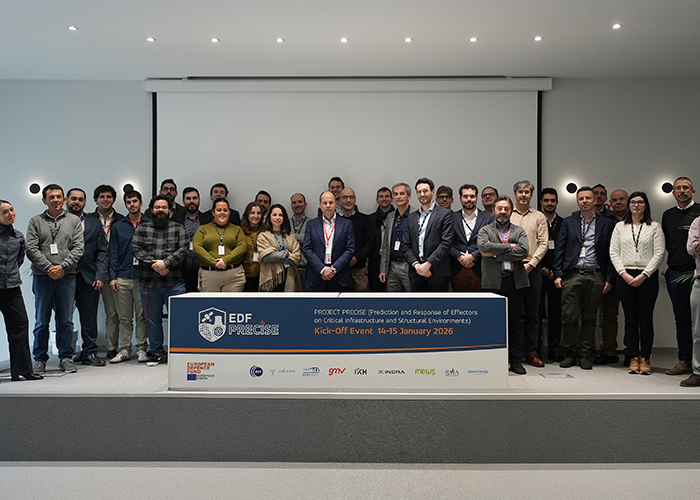
The European Defence Fund has officially launched PRECISE, a four-year research project aimed at strengthening Europe’s ability to model, assess and predict the impact of physical and cyber-physical threats on critical infrastructure and dense urban environments.
PRECISE (Prediction and Response of Effectors on Critical Infrastructure and Structural Environments) brings together industrial, research and academic partners from five EU member states under the coordination of GMV. The initiative is designed to address a growing capability gap in how defence and civilian authorities assess infrastructure vulnerability, resilience and potential cascading effects in complex, built-up environments.
For risk leaders, PRECISE reflects the increasing convergence of physical security, cyber risk and digital twins. The project will develop an advanced European toolbox that combines AI-driven automation with physics-based simulation to generate detailed 3D structural models of critical infrastructure and predict the effects of different threat scenarios.
The platform will ingest multi-source data from satellites, aerial systems and ground-based sensors, including electro-optical imagery, synthetic aperture radar and LiDAR. Using this data, PRECISE aims to automate the creation of high-fidelity digital representations of infrastructure and simulate how different effectors interact with those structures. The goal is to reduce uncertainty in planning, improve decision-making and help limit unintended or collateral impacts.
While driven by defence requirements, the project is explicitly dual-use. Use cases extend beyond military targeting and force protection to include resilient infrastructure design, urban planning, emergency preparedness and protection of nationally significant assets. As critical infrastructure becomes more interconnected and digitally modelled, the ability to predict second- and third-order effects is increasingly relevant to cyber risk and resilience strategies.
GMV will act as system integrator and coordinator, leading systems integration and demonstration activities. The consortium includes partners spanning aerospace, defence, analytics and sensing, as well as academic institutions such as the Royal Military Academy of Belgium and the Barcelona Supercomputing Centre.
Manuel Pérez Cortés, GMV’s general manager for defence and homeland security, said PRECISE represents a significant step toward improving European capabilities in structural modelling and effect prediction, while strengthening technological sovereignty. He said the project is expected to support demanding use cases related to infrastructure protection, operational planning and resilience, while enabling future military capability development and civilian spin-offs.
Following its formal kick-off, PRECISE has entered an initial phase focused on requirements definition, system architecture design and data collection planning. Over its four-year lifecycle, the project is expected to contribute tools and knowledge that help European organisations better anticipate, assess and manage risks to critical infrastructure in increasingly complex threat environments.