
New research published by Claroty has found tens of thousands of consumer internet-connected devices operating inside critical infrastructure networks, raising concerns about network governance and segmentation in operational technology (OT) and healthcare environments.
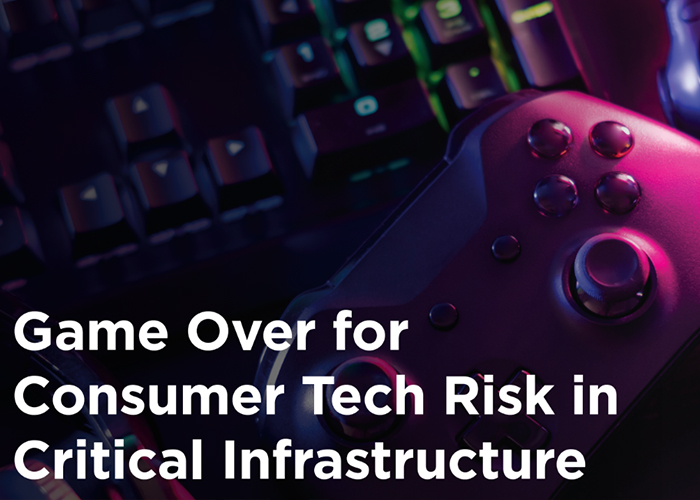
The report, titled “Game Over for Consumer Tech Risk in Critical Infrastructure”, is based on analysis of more than 45 million devices across 30,000 critical infrastructure sites. Claroty said it identified more than 65,000 “non-essential” consumer devices running alongside industrial and medical equipment.
Claroty’s findings point to risks from unmanaged or poorly managed endpoints, including devices that may run unpatched firmware, outdated operating systems, or have known vulnerabilities. The report also argues that consumer devices’ routine connections to external cloud services can introduce additional exposure through third-party-controlled links.
Key figures cited in the report include 16,745 gaming consoles detected on OT and healthcare networks, with the majority located in hospitals; 44,059 smart home and entertainment devices such as smartwatches, Sonos media players and Roku streaming sticks on OT networks; and 4,915 connected vehicles on OT networks, which Claroty said contained “hundreds of security issues”, including remote code execution vulnerabilities.
Claroty also reported that 95% of gaming consoles in healthcare environments were connected to production networks rather than isolated guest or IoT networks. By contrast, it said 71% of personal electronics such as smartwatches and smart speakers were connected to guest networks. For connected vehicles, Claroty said “almost none” were properly isolated onto guest networks, and the analysis identified six critical CVEs on Tesla Model 3 vehicles and 121 security issues linked to Ford F-150 trucks.
The company linked the issue to broader governance and architecture challenges, including “failures in virtual network segmentation, continuous threat detection, remote access, and overall governance”, particularly as connected devices proliferate across operational environments.
The report follows recent cyber incidents affecting refrigeration controllers used in supermarkets and blood banks, which Claroty cited as examples of how attacks on cyber-physical systems can affect service continuity.
Claroty also referenced the Australian Cyber Security Centre’s Annual Cyber Threat Report 2025–26, which it said attributed 10% of reported cyber incidents in FY2025–26 to critical infrastructure entities and noted growing capability among threat actors targeting OT environments.
“Finding consumer technology like Apple Watches and Nintendo Switches residing on the same networks as OT and medical equipment points directly to ongoing deficiencies in network governance and segmentation within operational settings,” said Sean Tufts, Field CTO at Claroty. “Addressing this issue does not mean stripping smart TVs from conference rooms or banning XBOX consoles from hospitals; it requires closing off unnecessary pathways for malicious actors from causing intolerable disruptions and negatively impacting businesses across industries.”
Claroty said organisations should focus on access controls, continuous asset discovery and stricter segmentation between guest, IoT and core production environments to reduce unmanaged entry points and limit lateral movement into mission-critical systems.
You can read the full report here.